

Market update
NSW farmland values and the rural property market: October to November 2026
Market Update No. 1 from LandMaps. Covers 1 October to 23 November 2026.
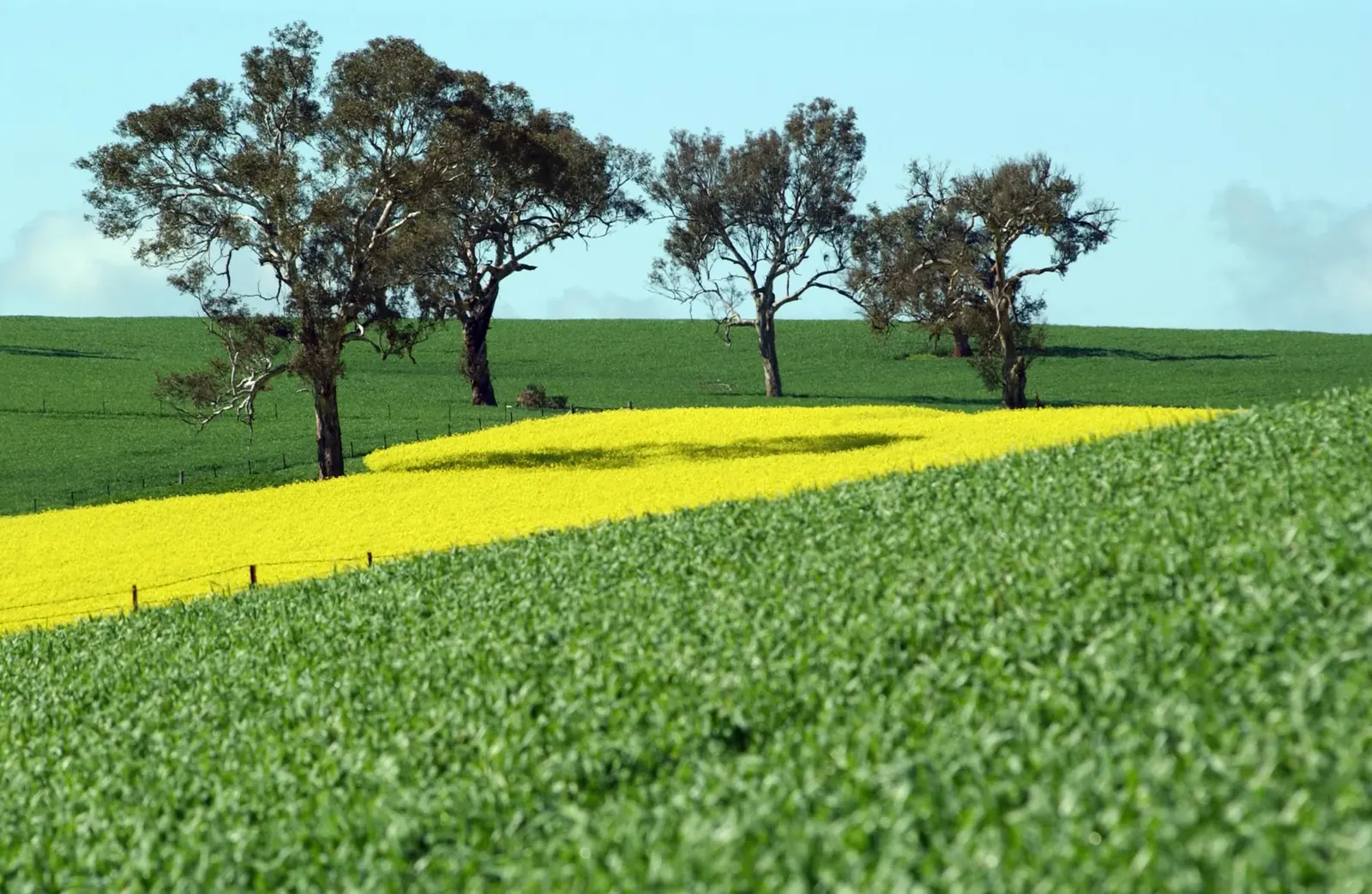
October rain turned the north around, the Reserve Bank lifted rates for the fifth time this year, and cattle prices went back above 1,000c. Underneath it all, the rural property market in NSW has settled into a pattern that buyers, sellers and valuers all seem to agree on: good country with water still sells well, and everything else is being picked apart.
This is our first monthly recap. Every figure below comes from a published source, listed at the end with its date.
Seasonal conditions: rain in the north, dry underneath in the south-east
Rainfall and temperature
The Bureau of Meteorology puts NSW October rainfall at 49.0 mm, just 2% above the long-term average. That statewide number hides a lot. Northern and north-eastern NSW finished above to very much above average, while parts of the south-west and the northern Central Tablelands were below. It was also warm: mean minimum temperatures were 2.59°C above average, making it the second-warmest October for overnight temperatures since 1910.
Around Moree, The Land reported many farms receiving 150–220 mm in late October, just as headers were about to roll.
The drought indicator
The shift on the Northern Tablelands was dramatic. Local Land Services figures show the share of the region in the Drought and Intense Drought categories of the NSW Combined Drought Indicator fell from 48.8% at 30 September to 2.9% at 31 October. LLS was careful to add that long-term deficits remain and warm weather will pull moisture down fast.
Further south the picture is less comfortable. DPIRD’s October update described drought conditions as highly variable across the South East, Hunter and Central Tablelands, and the Singleton Argus reported in late October that about 20% of the Hunter was rated as being in intense drought.
The outlook
The Bureau’s outlook issued 12 November gives a 60% to more than 80% chance of above-average December to February rainfall across much of eastern NSW, with the wet signal strongest in December. That sits alongside a strong El Niño. The Bureau points to unusually warm seas around south-eastern Australia as one reason the two signals can sit side by side.
Harvest and crops: two harvests in one state
ABARES’ December crop report is not due until 1 December, so its September edition is still the latest official forecast. It put the 2026–27 NSW winter crop at 13.1 million tonnes, down 30% on last year, with wheat at 7.7 Mt, barley at 2.9 Mt, canola at 1.2 Mt and chickpeas at 450,000 t.
On the ground, Elders called it a “two-speed harvest”. Rain kept interrupting northern headers and brought downgrades from sprouting and screenings, while deliveries in the Riverina and Lachlan picked up pace. By 19 November GrainCorp had received 2,331,400 tonnes at NSW up-country sites.
Plenty of northern growers who sowed into very little were pleasantly surprised. Croppa Creek’s Lee Coleman told The Land his first 1,000 ha averaged 4 t/ha off 138 mm of in-crop rain. “My reflection on the year is that we’ve had good luck, good timing and good seed variety.”
Commodities: cattle lead, wool eases
Cattle
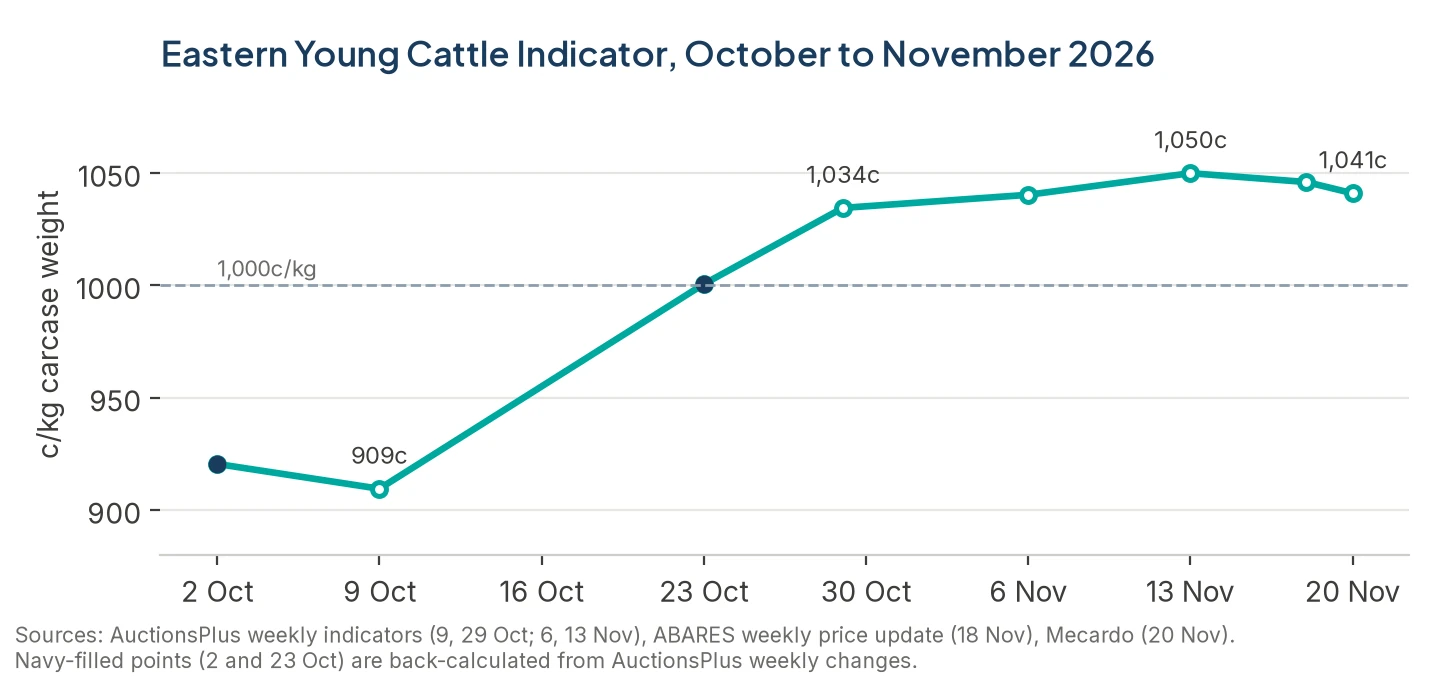
Cattle were the standout. The Eastern Young Cattle Indicator (EYCI) climbed from 909c/kg carcase weight on 9 October to 1,050c on 13 November, according to AuctionsPlus, and Mecardo had it at 1,041c on 20 November. MLA reported the Heavy Steer Indicator at a record 490c/kg liveweight in mid-November. The restocker bid behind October’s lift depends on the rain continuing, so a dry fortnight would test it.
Grain, wool and cotton
ABARES’ weekly price update (indicators to 19 November) had APW wheat at Port Adelaide at $434/t, 16% higher than a year earlier, and Kwinana canola at $782/t, down 5%. The Cotlook A index was 90.1 US cents/lb, up 20% on a year ago. The Eastern Market Indicator for wool eased from 1,820c/kg clean in early October to 1,738c by mid-November (ABARES weekly update).
Finance: a fifth rate rise and a softer dollar
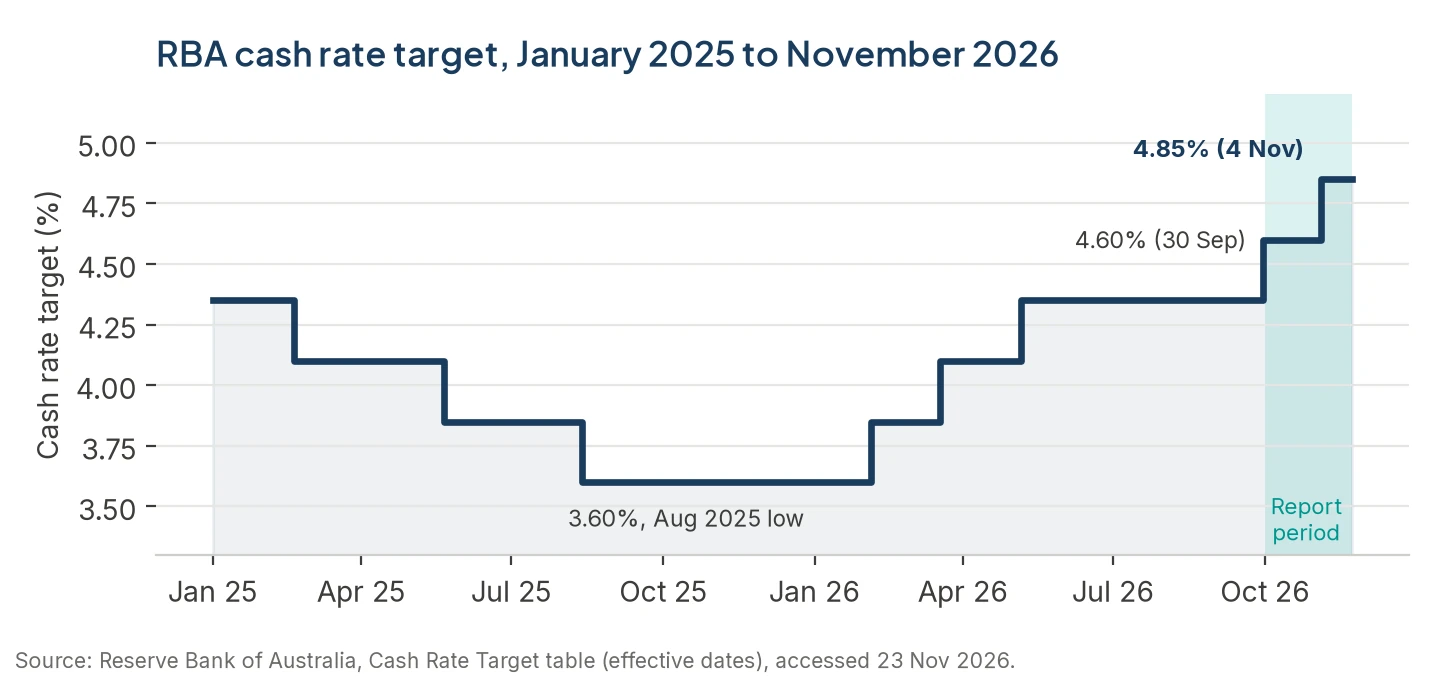
The RBA lifted the cash rate by 25 basis points to 4.85% on 3 November, its fifth increase of 2026. The Australian dollar fell to a 2026 low just above US66.5c on 19 November after weak jobs figures.
Inputs remain expensive. GrainGrowers’ 6 November report (Argus pricing) had urea at A$790–810/t FCA Geelong, while Sydney diesel terminal gate prices eased from 247.6c to 243.5c a litre over the week to 23 November, according to the Australian Institute of Petroleum.
The rural property market in NSW: buyers are paying for quality
What agents and valuers are saying
Herron Todd White’s October agribusiness report describes a two-tier market. Prime holdings with scale, water security and good infrastructure are still selling at or near benchmark rates, often to neighbours expanding. Properties that need capital or lack water are taking longer, and Central West and Western NSW values have “generally plateaued”.
Colliers’ agribusiness team, writing via AuctionsPlus in November, described the market as “neither in retreat nor in an untethered boom”. Enquiry is strong, but buyers are taking longer to commit.
Notable NSW farm sales
| Property (district) | Area | Price | Rate reported |
|---|---|---|---|
| Barwon Vale (Walgett) | 4,524 ha | $9.3m | ~$2,056/ha |
| Burley (Woodstock, near Cowra) | 757 ha | $10.8m | ~$14,267/ha |
| Collyburl (Narromine) | 350 ha | $2.86m | ~$8,171/ha |
| One Tree Hill (Maryvale, near Dubbo) | 357 ha | $2.9m | ~$8,123/ha |
| The Lease (Trangie) | 1,020 ha | $6.94m | ~$6,804/ha |
| Rocky Creek Aggregation (north-east of Ashford) | 4,246 ha | $18m | n/a |
Neighbours and locals did most of the buying, and the strongest results went to country with secure water. Bidding depth was thin: Collyburl had three active bidders and One Tree Hill three registered. The biggest deal of the period was the reported $300 million purchase of the Deniliquin aggregation, including the Boonoke and Wanganella studs, by the Shippen family’s Banyandah Pastoral.
Benchmarks
Bendigo Bank’s 2026 Farmland Values Report put the NSW median at $9,884/ha after growth of 4.5% in 2025, the slowest in its twelve-year run. We could not find a published NSW rural auction clearance rate for the period, so we have not quoted one.
NSW land values 2026: what the Valuer General has published
Values at 1 July 2026
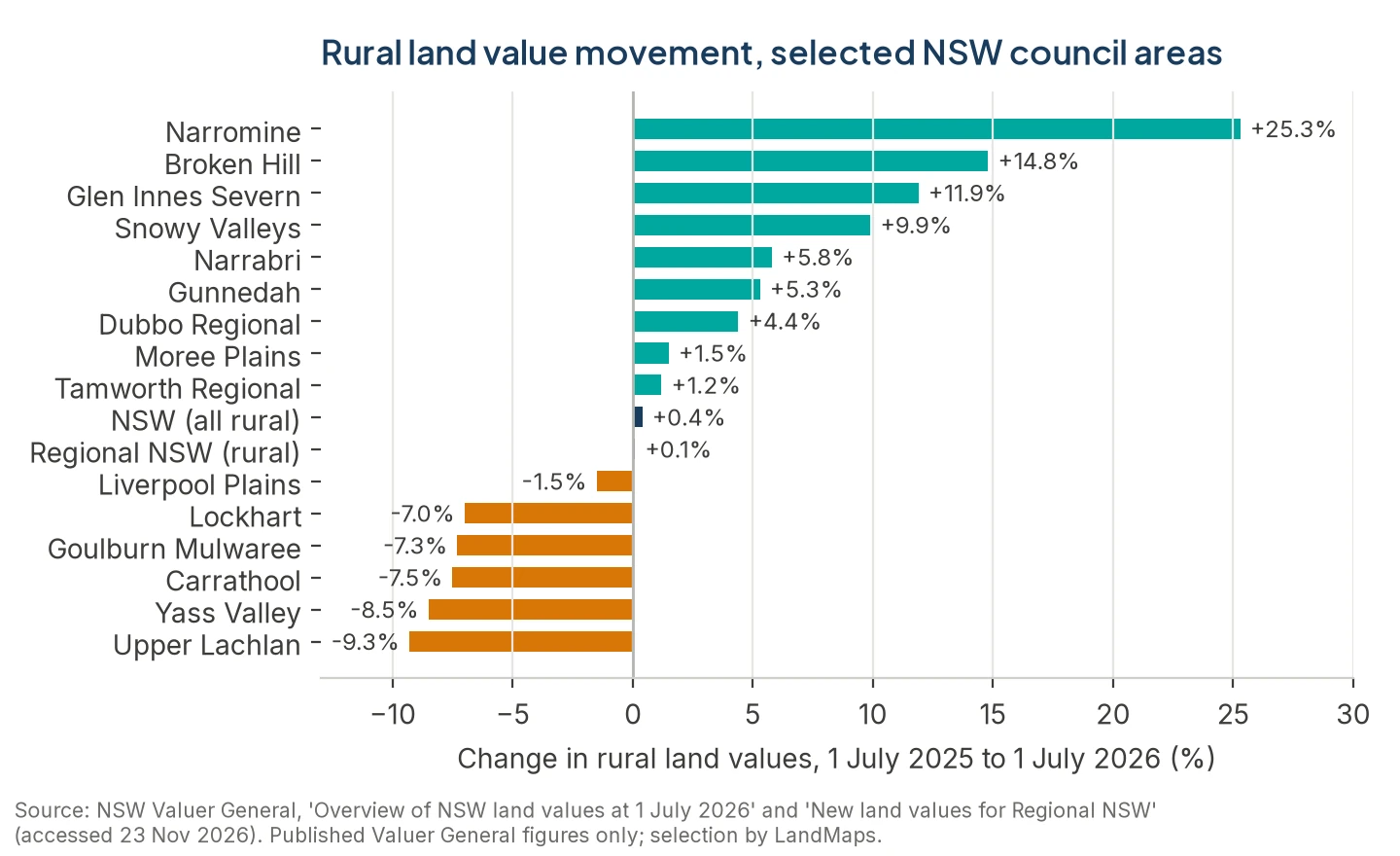
The Valuer General’s new values are out. At 1 July 2026, total NSW land value was $3.19 trillion, up 3.0%. Rural land rose just 0.4% statewide to $307.64 billion across 244,033 properties, and only 0.1% across Regional NSW. That follows a 0.4% fall in rural values in the year to 1 July 2025.
The spread underneath is wide. Narromine’s rural values rose 25.3%, while Upper Lachlan fell 9.3% and Yass Valley 8.5%. Valuer General Sally Dale said the statewide result “does not tell one uniform market story”, and that buyers in weaker markets became more price-sensitive after earlier strong growth.
What to watch
- About a third of councils receive new values this year, with Notices of Valuation arriving between November 2026 and March 2027.
- Objections must be lodged within 60 days of the notice’s issue date, ideally backed by recent sales evidence.
- Revenue NSW will issue 2027 land tax assessments from January using these values.
These are statutory values set at a single date and exclude improvements, so they will not match farm sale prices. On a lot, LandMaps shows the indicative Valuer General figures returned for that property.
Outlook: what to watch in December
- 1 December: ABARES’ December crop report gives the first official update on NSW production since September.
- 7–8 December: the RBA meets. CommBank expects no change.
- 9 December: expressions of interest close for Palmerston, Armidale (AuctionsPlus), a test of New England demand.
- December: Rabobank’s fourth-quarter Rural Confidence Survey, the first sentiment read since the November rate rise.
We expect the split between top-tier and secondary country to keep widening. Watch summer listings in the northern districts that just had rain. Better feed and firm cattle prices could bring more country to market before Christmas.
About this update
This monthly update is produced by LandMaps, the free NSW property and land intelligence map. The next edition will be published on Market Insights.
General information only, not financial, legal or investment advice. Figures are from the sources below as at their publication dates.
Sources
- Bureau of Meteorology, New South Wales in October 2026, monthly climate summary, 3 Nov 2026.
- Bureau of Meteorology, Climate outlook for December to March, issued 12 Nov 2026.
- Northern Tablelands Local Land Services seasonal update, via STA FM, 9 Nov 2026.
- Southern NSW Drought Resilience Adoption and Innovation Hub, October seasonal conditions update (citing NSW DPIRD), Oct 2026.
- Singleton Argus, “Rural Aid heads to Singleton as farmers battle intense spring drought”, 24 Oct 2026.
- ABARES, Australian Crop Report, September 2026; ABARES release schedule 2026.
- Elders, Cropping market update, 17 Nov 2026.
- GrainCorp, Harvest Update, 19 Nov 2026.
- The Land, “Good timing and good luck”, 16 Nov 2026.
- AuctionsPlus, Indicators reports, 9 Oct and 13 Nov 2026; Mecardo, 20 Nov 2026.
- Meat & Livestock Australia, Weekly cattle and sheep market wrap, 20 Nov 2026.
- ABARES, Weekly commodity price update, indicators to 19 Nov 2026.
- Australian Wool Innovation, weekly price report, 9 Oct 2026 (EMI at 18 Nov from ABARES, source 12).
- Reserve Bank of Australia, Monetary Policy Decision, 3 Nov 2026; Cash Rate Target table; Board meeting schedule 2026.
- FXStreet, “Aussie Dollar falls to a 2026 low”, 19 Nov 2026.
- GrainGrowers, Market Update and Fertiliser Report, 6 Nov 2026; Australian Institute of Petroleum, Terminal Gate Prices, 17–23 Nov 2026.
- Herron Todd White, October 2026 agribusiness report.
- AuctionsPlus, “Rural property buyers turn ruthless as divide widens”, 11 Nov 2026.
- The Land, sale reports for Barwon Vale (1 Oct), Boonoke/Wanganella (12 Oct), Burley (6 Nov), Collyburl (19 Nov), One Tree Hill and The Lease (20 Nov 2026).
- Bendigo Bank, 2026 Australian Farmland Values Report media release, 5 May 2026.
- NSW Valuer General, Overview of NSW land values at 1 July 2025 (25 Nov 2025); New land values for New South Wales and Regional NSW (1 July 2026), accessed 23 Nov 2026.
- Rabobank, Rural Confidence Survey media release, Sep 2026.
Last reviewed 23 November 2026.
Questions
Are NSW farmland values still rising?
Slowly. Bendigo Bank's report showed the NSW median farmland price up 4.5% in 2025, and the Valuer General's statutory rural land values rose 0.4% in the year to 1 July 2026. Agents report prime country holding firm while secondary country takes longer to sell.
What did the NSW Valuer General's 2026 land values show for rural land?
Rural land values rose 0.4% statewide to $307.64 billion at 1 July 2026, and 0.1% across Regional NSW. Changes ranged from +25.3% in Narromine to -9.3% in Upper Lachlan.
How are interest rates affecting the rural property market in NSW?
The RBA raised the cash rate to 4.85% on 3 November 2026, its fifth rise of the year. Colliers and Herron Todd White both describe buyers as more selective, with debt-funded buyers taking longer to commit.
When will I get my new land valuation notice?
The Valuer General says Notices of Valuation for 1 July 2026 values are being issued between November 2026 and March 2027. You have 60 days from the issue date to lodge an objection.
How can I check the land value and soils of a NSW property?
LandMaps lets you search any NSW lot by lot and DP or address and see soils and land capability, vegetation, bush fire prone land and Valuer General land values on one map. It is free to try.